“We Are Not a Multi Culture” – UTK Takes Over London

London, Under Red and White
The Strand did not feel like ordinary London today. It felt louder, older, angrier, and more religious than the city usually allows itself to be. Unite the Kingdom had arrived in central London, and for several hours the area around the Strand and Parliament Square was taken over by flags, chants, banners, speeches, phone cameras and a crowd that clearly wanted to be seen.
The dominant colours were red and white. St George’s Crosses were everywhere, carried by young men, older couples, priests, families, veterans and people who looked as though they had come straight from ordinary Saturday life. Alongside them were Union flags, Christian banners, the flag of the Holy Sepulchre of Jerusalem, and more unexpected symbols: American flags, Iranian flags, Israeli flags and MAGA-style Trump imagery.
It was British patriotism, but not the soft, official kind seen at royal events or state ceremonies. This was rougher, more suspicious and more confrontational. It was also far more openly Christian. The message running through the day was that Britain had lost something sacred, and that those gathered had come to take at least the streets back.

“We Are Not a Multi Culture”
The phrase “We are not a Multi Culture” captured the tone of the day better than any polished campaign slogan could. This was not simply an anti-government protest, nor just another march about immigration. It was about identity. Many in the crowd were not asking for a better-managed multiculturalism. They seemed to reject the premise altogether.
That is what gave the demonstration its force. The argument was not made in policy papers or careful Westminster language, but through symbols: crosses, flags, hymns, slogans, images of martyrs, warnings about civilisational decline and repeated appeals to Christianity.
There was something intimidating about it. Not necessarily violent, but heavy. The number of flags, the religious imagery, the chants and the scale of the crowd gave the protest a hard edge. It was not designed to ask politely. It was designed to assert.
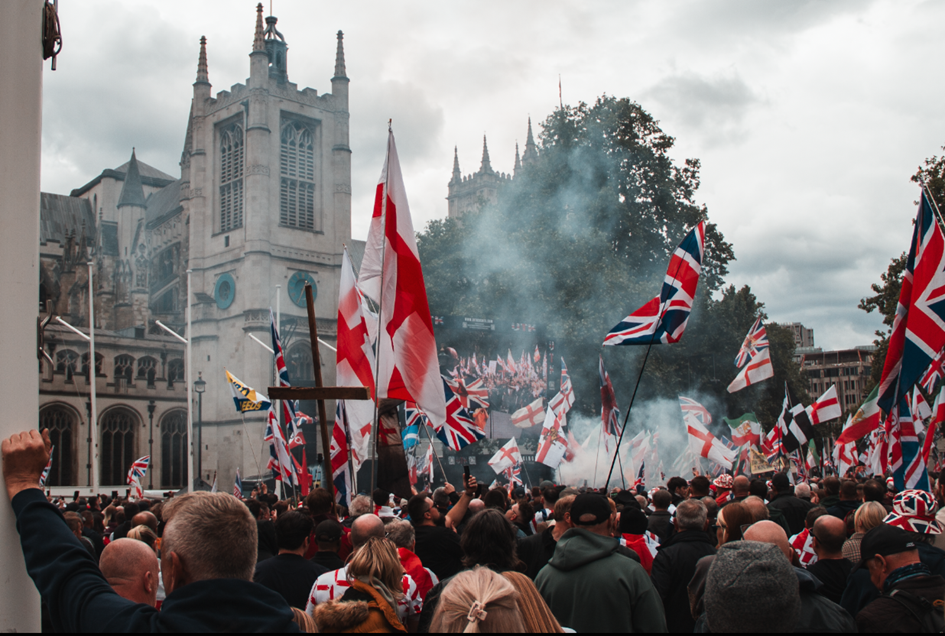
A Crowd Harder to Dismiss Than Its Critics Would Like
One of the most noticeable things about the day was the crowd itself. It would be easy, and politically convenient, to pretend it was made up of one type of person. It was not.
There were working-class men who looked as though they had been to dozens of these events before. There were older women wrapped in flags. There were young people filming everything for TikTok and X. There were priests and committed Christians. There were people who looked like academics, local campaigners, party activists and ordinary families. There were pensioners, veterans and people who had clearly travelled into London from elsewhere.
That mixture mattered. Whatever one thinks of Unite the Kingdom, this did not look like a tiny fringe dragged out for a photo opportunity. It looked like a gathering of people who believe the country has changed beyond recognition and that nobody in Westminster is prepared to say so honestly.
The class mix was especially striking. This was not simply a working-class protest, although there was a strong working-class presence. It was not a middle-class activist gathering either. It cut across the usual social lines in a way that mainstream parties would be foolish to ignore.
A Loud Day, Not a Street Battle
For all the noise, anger and aggressive atmosphere, the protest did not, to our knowledge, descend into major violent confrontation on the route itself. The crowd was loud. It was defiant. It was not trying to appear respectable in the soft, managed, media-friendly sense. But loudness is not the same as violence.
The police operation was enormous. Reuters reported that around 4,000 officers were deployed across London for the rival protests, while the Metropolitan Police said 31 arrests had been made across the operation by about 4.30pm. Reuters also described the day as passing largely without significant incident.
None of that made the atmosphere relaxed. It was not relaxed. There were moments when the chants, flags and sheer mass of people felt overwhelming. But the point of the day was pressure, not disorder. It was political theatre with a warning attached.
The Speakers and the Movements Around Them
The speaker list reflected the strange breadth of the event. Liam Tuffs, Andrew Bridgen, Glenn Beck and Kellie-Jay Keen were among the names associated with the day, while Tommy Robinson remained the figure around whom much of the emotional energy gathered.
Also present were the Pink Ladies, Reform UK supporters, Revive UK, Reform, UKIP and a number of smaller parties and movements. Nick Tenconi, the head of UKIP, was also spotted at the march. The Guardian noted his previous comments about using the military to “round up and deport the Islamists, illegals and the communists”.
The result was not one disciplined political machine. It was a meeting point for several currents of the British right: nationalist, Christian, anti-immigration, anti-Islam, women’s rights activists, populists, anti-establishment campaigners and people who have lost trust in both main parties.
That breadth gave the protest its energy. It also meant the message kept shifting. One moment the focus was Islam. The next it was immigration. Then Nigeria. Then Iran. Then Israel. Then America. Then Christianity. Then Trump. Then the failures of Britain’s political class.
It was powerful, but restless.
Christianity in the Open
The Christian character of the protest was impossible to miss. This was not the vague cultural Christianity of Christmas carols, Remembrance Sunday or royal ceremonies. It was sharper than that. It was Christianity as identity, inheritance and defence.
Priests and Christian activists gave the day a seriousness that ordinary party-political rallies often lack. Religious symbols were not decoration; they were part of the argument. Britain was presented not merely as a legal arrangement, an economy or a passport, but as a Christian country whose foundations have been denied by its own rulers.
One of the more striking moments came when a Nigerian priest was brought forward. He spoke not as an abstract symbol, but as someone who had lived close to anti-Christian violence himself, having reportedly almost been kidnapped in Nigeria. His presence gave the discussion of Christian persecution a human weight that statistics and slogans rarely manage. For a crowd already convinced that Christianity is under threat at home and abroad, it was one of the moments that cut through the noise.
That will resonate with many people who feel Christianity has been pushed out of public life while every other identity is protected, promoted or excused. It will also alarm those who hear in this language something narrower and more exclusionary.
The Christianity on display was not gentle parish-hall Christianity. It was defensive, crusading and sometimes apocalyptic. It saw Britain as something under siege.

The Screens, the Songs and the AI Gloss
There was another side to the day that sat awkwardly beside all the talk of heritage and tradition. The event made heavy use of artificial intelligence. AI-generated images appeared on flags and screens. AI-style songs and videos helped shape the atmosphere. Large digital visuals turned the protest into something closer to a rolling culture-war broadcast than an old-fashioned march.
At times it worked. The screens gave the rally scale and drama. They helped turn individual frustrations into a shared emotional experience. The crowd was not just listening to speeches; it was being shown a story about decline, betrayal, martyrdom and resistance.
Still, the artificial quality was hard to ignore. For a movement speaking so much about memory, inheritance and authenticity, there was something strange about seeing synthetic imagery carry the message. Ancient Christian symbols and national flags sat next to AI-made visuals and digitally produced songs.
The contrast almost said too much: a movement longing for the past, using the newest tools of political performance to get there.
Many Causes, One Mood
Unite the Kingdom was at its strongest when it focused on Britain: immigration, national identity, Christianity, free speech and the feeling that ordinary citizens are being pushed aside by a political class that no longer cares what they think.
It became less convincing when the message spread too widely. The event moved through anti-Islam rhetoric, anti-immigration anger, concern over Christian massacres in Nigeria, the testimony of a Nigerian priest who had reportedly nearly been kidnapped, sympathy for Iran, support for Israel, American conservative politics and general hostility towards the British establishment.
All of these issues may matter to different parts of the crowd, but together they did not always form a clear political case. The Guardian and Reuters both described the march as far right, and that is the label much of the press will use. Yet the day itself felt less like one single ideology and more like a mass of grievances that had found the same stage.
Some people were there because of Islam. Some because of immigration. Some because of women’s rights. Some because of Christianity. Some because of grooming gangs. Some because of free speech. Some because they believe Britain has been humiliated by its own leaders.
It was not one argument. It was a stack of them, piled high and waved under the same flags.

The Battle Over the Numbers
By late afternoon, the argument had already moved from the streets to the numbers.
The Guardian reported that organisers of the pro-Palestine Nakba Day rally claimed at least a quarter of a million people had attended, making it, in their words, “10 times bigger” than the Unite the Kingdom demonstration. The same report said early Metropolitan Police estimates put the Tommy Robinson march at around 60,000, down from the 150,000 the Met estimated at his September demonstration.
On paper, that makes the day look simple: one protest vast and moral, the other smaller and fading. On the ground, it felt less tidy.
Having attended the pro-Palestine protest ourselves, the claim of 250,000 felt difficult to square with what we saw. It was certainly large, organised and visible. It had the banners, the chants, the stewards and the activist infrastructure that have become familiar at London’s Palestine marches. But it did not appear to us to be ten times the size of Unite the Kingdom.
That matters because protest numbers are never just numbers. They are part of the performance. Organisers want scale. Opponents want decline. Police estimates often become the closest thing to an accepted figure, but even they are contested. The Times reported a very different picture from the organisers’ claim, putting the pro-Palestine march at around 15,000 to 20,000 while also reporting roughly 60,000 at Unite the Kingdom. The Guardian’s live coverage later cited a police estimate of up to 20,000 for the pro-Palestinian march.
For Unite the Kingdom, 60,000 is still a serious number. It is not a fringe gathering. It is not a few angry men shouting at traffic. But if the Met’s early estimate is right, the decline from September also says something. The movement can still fill streets, but perhaps the spectacle is no longer expanding in the way its supporters hoped.
The pro-Palestine protest, meanwhile, had the advantage of familiarity. London knows that march now. The route, the chants, the placards, the moral vocabulary, the activist groups — all of it has become part of the city’s political routine. Unite the Kingdom felt rougher, stranger and less accepted, but also more charged.

Two Londons Passing Each Other
The strangest thing about the day was that the two protests seemed to exist in completely different moral universes while occupying the same city.
The Nakba Day march presented itself as humanitarian, anti-racist and internationalist. Unite the Kingdom presented itself as patriotic, Christian and defensive. Each side saw itself as the decent one. Each side saw the other as dangerous.
But the contrast was not as simple as the headlines will make it. The pro-Palestine march was not, from our view, the overwhelming people’s uprising its organisers described. Nor was Unite the Kingdom merely a handful of extremists wrapped in flags. One side is more acceptable to London’s activist class. The other is more likely to be condemned by Westminster, the press and the respectable centre. Both, however, drew from real currents in British public life.
The difference was tone. The Nakba Day march felt familiar, almost institutional. Unite the Kingdom felt rawer and more volatile. It had less polish, but more cultural charge. It was not just asking for policy change. It was saying that the country itself had been stolen, diluted or betrayed.
That is why the size question matters, but only up to a point. Whether Unite the Kingdom had 50,000, 60,000 or more, the important fact is that tens of thousands were willing to stand openly behind a message most of the political class considers unacceptable. Whether the Nakba Day march had 20,000, 50,000 or 250,000, the important fact is that pro-Palestine mobilisation remains one of the most established protest forces in London.
The numbers will be argued over. The mood was harder to miss.

A British Protest Looking Abroad
One of the stranger features of Unite the Kingdom was how much of it looked beyond Britain. For an event with that name, there was a surprising amount of attention given to foreign countries and foreign political figures.
The American presence was especially visible. American flags appeared throughout the crowd. Trump imagery was easy to spot. MAGA-style symbolism blended with British flags as though the two belonged naturally together. There were also Israeli and Iranian flags, adding to the sense that the rally was not only about Britain, but about a wider civilisational and geopolitical struggle.
That international framing may appeal to those who see themselves as part of a global movement against liberalism, Islamism, mass immigration and secular progressivism. But it also diluted the Britishness of the day. A protest about the United Kingdom loses some of its force when it starts to feel like a branch meeting of American conservatism.
The people around us seemed most engaged when the focus was Britain. The energy changed whenever the speeches drifted too far across the Atlantic.
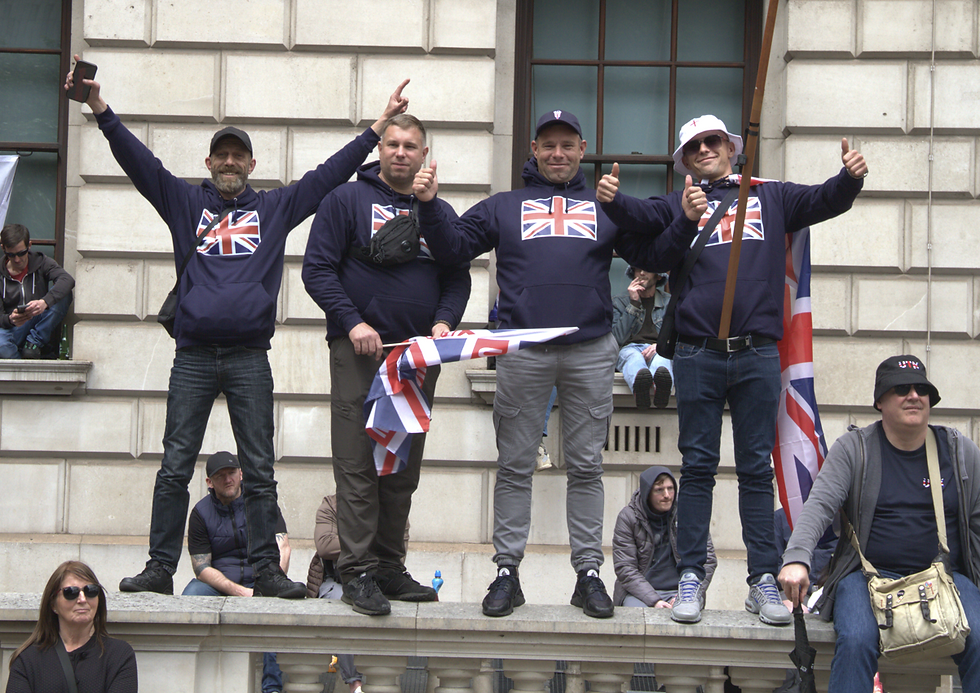
Tommy Robinson and the Charlie Kirk Moment
That tension became clearest during Tommy Robinson’s tribute to Charlie Kirk. Robinson honoured Kirk as a “martyr” and called for an international “Charlie Kirk Day”. A tribute played on the large screens, followed by a song dedicated to him.
It was meant to be a moment of international solidarity. Instead, it seemed to reveal something more complicated. As Robinson moved into American conservative territory, many protesters began leaving Parliament Square. Very few appeared eager to join the chants.
That reaction said more than any speech could. The crowd had come for Britain. It had come for immigration, Christianity, national identity and anger at Westminster. It had not necessarily come to mourn an American political figure or take part in imported mythology.
There is a lesson in that. The British right may borrow media style, tactics and language from America, but it cannot become American without losing something.
British patriotism has its own grammar. It does not need to dress itself in MAGA colours to be taken seriously.
The Edges of the Day
There were darker details around the margins. The Guardian reported that a man was arrested in London after an incident in Birmingham in which a man was run over by a van after flags were removed from lamp-posts. Officers arrested the suspect at Euston station near the meeting point of the Unite the Kingdom march. Another man was arrested on suspicion of encouraging people to attack a police officer.
Those incidents did not define the whole day. They should not be used lazily to describe everyone who attended. But they did form part of the surrounding atmosphere: tense, suspicious and never far from escalation.
This is the difficulty with a movement like Unite the Kingdom. Much of the crowd was made up of ordinary people with real concerns. But the edges are sharp. Some of the language is ugly. Some of the company is uncomfortable. And the harder the rhetoric becomes, the easier it is for opponents to dismiss the entire thing as a danger rather than a warning.
Patriotism or Performance?
Unite the Kingdom proved that this kind of politics is not going away. If anything, it is becoming more confident. The people who came today were not embarrassed. They were not hiding. They were prepared to stand in the middle of London and say that multicultural Britain has failed, that Christianity belongs at the centre of national life, and that immigration has changed the country in ways they no longer accept.
That is politically significant, whether Westminster likes it or not.
But the day also showed the limits of raw atmosphere. Flags can create unity for an afternoon. Speeches can lift a crowd. Screens can make a movement look larger than life. But political seriousness eventually requires more than mood. It requires discipline. It requires knowing what the main demand is. It requires knowing what comes after the march.
UTK had numbers, noise and symbolism. It had anger and faith. What it did not always have was an answer to the obvious question: what exactly now?
What the Day Said About Britain
The most important thing about today was not any single speech. It was the fact that so many different people were willing to gather under this banner at all.
There is a portion of Britain that feels culturally dispossessed. It believes the country has been changed without consent. It sees Christianity mocked or ignored, borders treated as optional and national identity reduced to something embarrassing. It does not trust the BBC, the police, the universities, the churches, Parliament or the courts to defend it.
That feeling is real. It will not disappear because commentators call it ugly. Nor will it become coherent simply because thousands of people gathered in London with flags.
The protest was a warning, but also a mirror. It showed a country in which patriotism has become both more necessary and more volatile. It showed a right with energy, but not yet enough order. It showed a public mood that mainstream politics continues to underestimate.
Unite the Kingdom took over the Strand today. Whether it can take hold of anything deeper will depend on whether it can become more than a spectacle: less borrowed American theatre, more British seriousness; less digital noise, more direction; less scattered grievance, more national purpose.




Comments